

Which commercial challenges do semi-finished product businesses face?

What is the semi-finished products industry?
The semi-finished products industry produces intermediate goods—materials that have undergone initial transformation but require further processing, shaping, or assembly before reaching end consumers. These businesses operate almost exclusively in the business-to-business (B2B) supply chain.
Semi-finished products can either be standardised components, or custom or engineered products. This distinction impacts the way these companies market, sell and service their products.
Challenges and needs for standard components manufacturers
Typically, companies in standard components have these four major business needs:- Traditional sales motion, with a strong focus on price/volume, and low customer loyalty. Sales rely heavily on visits and trade shows.
- Online Sales: direct-to-customer capabilities via Webshops.
- Indirect Sales: managing distribution networks, resellers, and partners.
- Demand Generation: leveraging marketing to systematically generate market demand.
Alongside these, they usually see four core challenges:
- CRM Adoption Barriers: experienced sales teams exhibiting resistance to new software and data entry.
- Global Competition: influx of low-cost products forcing a pivot to service- and relationship-based value.
- Customer loyalty: standardised products lead to high competition and low switching costs.
- Siloed Information: critical details and histories trapped in spreadsheets and legacy ERPs.
Challenges and needs for custom products manufacturers
Companies in custom products are also rather traditional in their approach, but may differ in their commercial approach because of:
- Long, Complex Sales Cycles: supporting multi-stakeholder buyer journeys and high-investment evaluations.
- Value & Spec-Based Selling: differentiating on technical specifications, ROI, and total cost of ownership (TCO).
- Indirect Channel Motion (B2B2B): partnering effectively with dealer and reseller networks to extend market reach.
- Branded B2B Marketing: driving marketing-led demand (both online as via trade shows) and brand positioning for high-value end products.
- Field Service Management (FSM): turning maintenance, spare parts, and service contracts into high-margin revenue drivers.
Alongside these, they usually see four core challenges:
- CRM Adoption Barriers: overcoming sales team inertia and resistance to routine software logging.
- Dealer & Reseller Disconnect: lack of direct visibility into end-user accounts and assets trapped in channel networks.
- Complex SLA Maintenance: coordinating on-site preventative and reactive field maintenance under strict SLA terms.
- Installed Base Integration: unifying traditional CRM records with ERP data, asset history, and service contracts.
Solution architectures
In this business context, the sales team is very close to the business operations. Producers or standard components needs a tight logistic integration, while companies focused on custom or engineered products also need a close relation with product development and R&D teams.
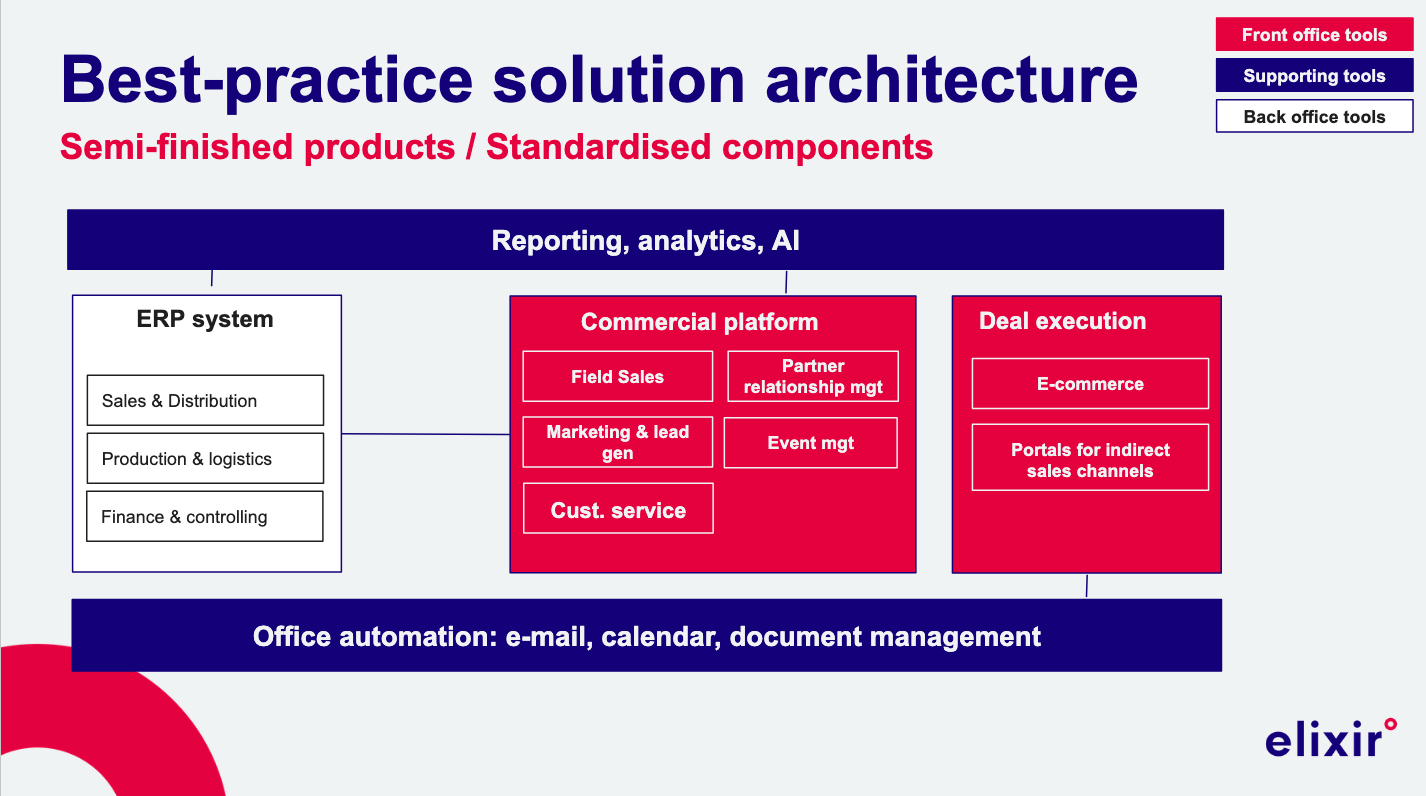
As a result, a lot of companies have build their commercial operations around the ERP team, which is not a best practice. Elixir solves this by connecting the commercial platform with the backend systems, so the sales people can be pulled away from the ERP and ensure they have a simple yet powerful CRM.
What does this CRM need to support?
- Field sales and relationship building
- Tradeshows (event management) and all other marketing campaigns and lead gen
- Email and calendar integration
- Customer service
- Simple enough to get easily adopted by experienced sales people
This commercial platform, integrated with your ERP system (both SAP and others), will also yield better reporting and improved office automation.
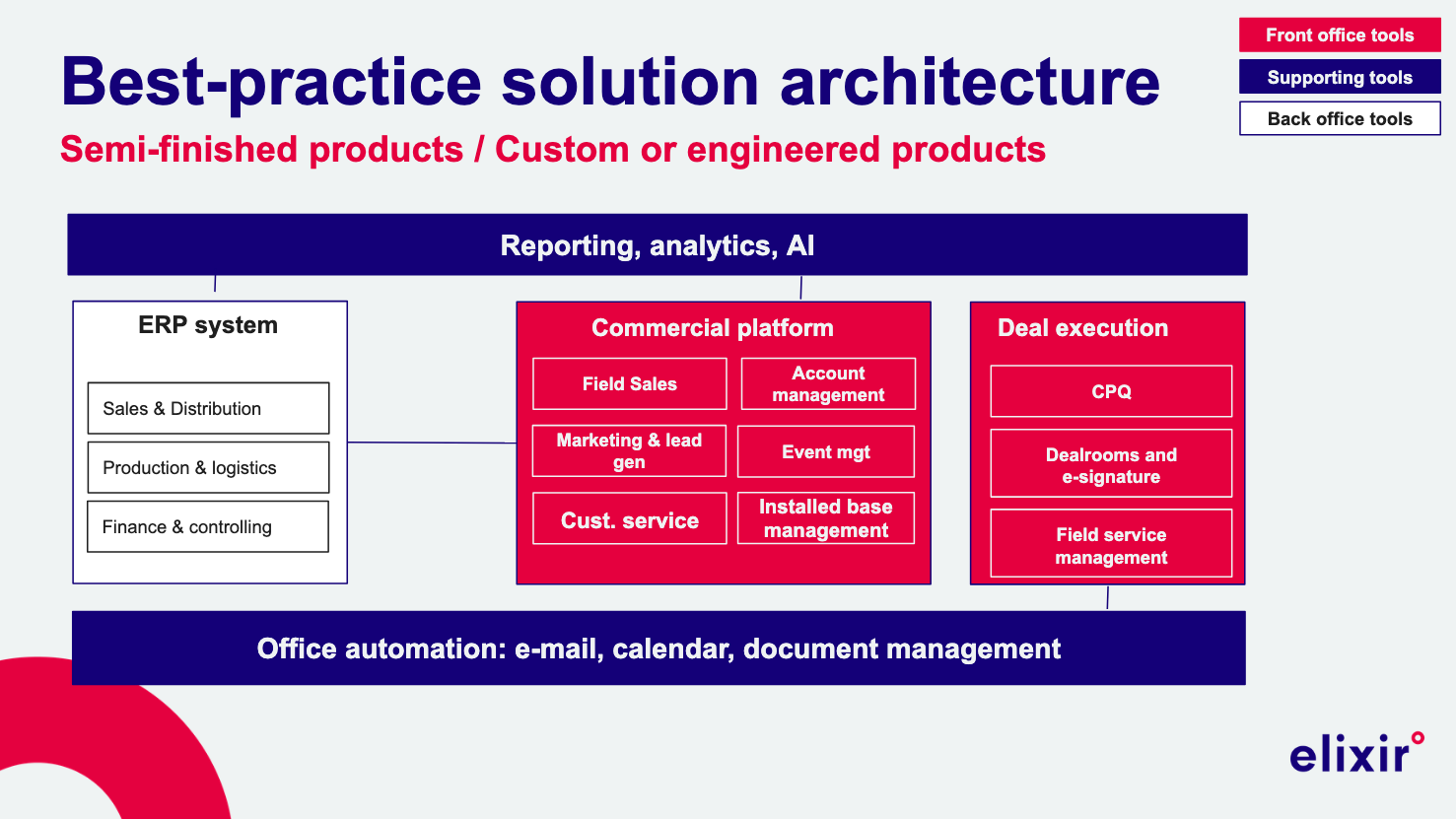
The solution architecture for business that delivery non-standardised products can differ. They may also need robust configuration and pricing tools (certainly for custom or engineered products) dealrooms and contract lifecycle management solutions, along with installed base management and field service applications.
Discover the way we work here
Can we help you?

See real customer stories & results

Knauf's HubSpot-Salesforce Integration for Global Operations
Describe how the business has helped you achieve the desired results with your company's services.

Bosch Rexroth overcame commercial department disconnection and gained unified customer visibility with HubSpot and SAP C4C integration.
