
Which commercial challenges do process industries face?

What is the process industry?
The Process Industry encompasses economic sectors that convert raw bulk materialsinto intermediate goods through thermal, chemical, biological, or physical transformations. Rather than assembling distinct mechanical units, this sector focuses on processing high-volume flows of liquids, gases, powders, and slurries at an industrial scale., with activities like mining; steel, plastic and chemicals; oil and gas; glass production;...
These companies mainly focus on operational efficiency for margin optimisation in long term contracts. As far as their marketing activities are concerned, they mostly focus on market analytics; their sales capabilities tend to be limited to relation based selling. These companies are inmany cases large, oligopolistic players.
Needs and challenges
Typically, they have these four major business needs:
- Long-Term Account Retention: managing multi-year, contract-based buyer relationships with tight, low-margin agreements.
- High-Touch Field Sales Support: equipping sales reps who conduct frequent on-site visits with mobile account data and history.
- Trade Show Lead Capture: digitizing lead qualification and nurture workflows around key industry fairs and exhibitions.
- Service-Driven Differentiation: delivering responsive, proactive customer service to safeguard long-standing accounts from churn.
Alongside these, they usually see four core challenges:
- CRM Adoption Barriers: experienced sales teams exhibiting resistance to new software and administrative data entry.
- Low-Cost Global Competition: influx of cheap products (e.g., from China) forcing a pivot to service- and relationship-based value.
- Under-Digitalized Marketing: immature marketing functions lacking digital lead scoring, campaign tracking, and nurture capability.
- Siloed Account Information: critical contract details and communication histories trapped in spreadsheets and legacy ERPs.
Simple yet powerful CRM as a solution
In this business context, the sales team is very close to the business operations. Sales requires a simple CRM, but with a view on what happens in the backoffice (ERP). In some cases we even see sales peoples that work in the ERP system, which is pretty inefficient, but it illustrates the operational focus.
Marketing is typically la bit ess developed, focused on trade shows and basic email marketing..
All this makes the solution architecture very much ERP oriented. Too much ERP oriented sometimes for sales, because they are lacking an adopted CRM in many cases. 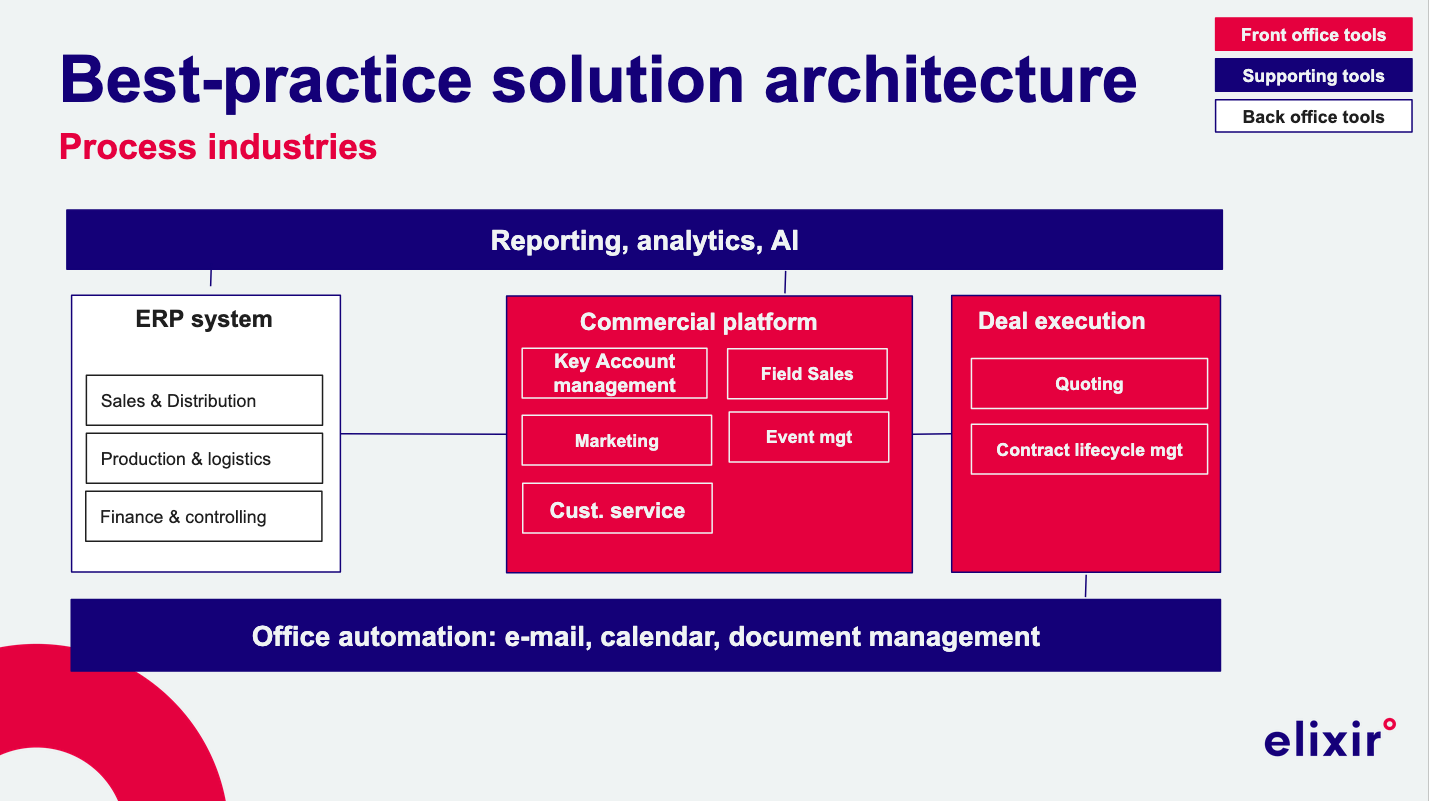
A best practice is to pull away all sales people from ERP and ensure they have a simple yet powerful CRM.
What does this CRM need to support?
- Field sales and relationship building
- Tradeshows (event management)
- Email and calendar integration
- Customer service
- Simple enough to get easily adopted by experienced sales people
This commercial platform, integrated with your ERP system (both SAP and others), will also yield better reporting and improved office automation.
We can also add a CPQ system to this, in order to greatly simplify your deal execution processes.
Discover the way we work here
Can we help you?